 Flowo
For reading and memorising, background music usually does not help, and songs with lyrics do the most harm, so silence or quiet instrumental music is the safer choice. Simple, repetitive work copes with music well. The evidence is moderate: large reviews agree on a small cost to reading, but the experiments are short and one recent meta-analysis reports a small benefit for learning.
What the research says
Lyrics do the most damage. A Bayesian meta-analysis of 65 studies found that noise, speech and music each have a small but reliable detrimental effect on reading, and that intelligible speech and lyrical music disrupt it most (Vasilev et al., 2018). In a within-subjects experiment with 30 readers, comprehension was higher in quiet than with lyrical music, whether people liked the song or disliked it, while quiet and instrumental music did not differ (Perham & Currie, 2014).
With instrumental music, speed and volume matter. Thompson et al. (2012) had people read passages while instrumental music played at two tempi and two volumes. The fast, loud version was the one condition that pulled comprehension significantly below silence.
Hard tasks pay the cost; easy ones mostly do not. Counting the direction of effects across 154 experiments, Cheah et al. (2022) found harm on memory and language tasks and larger costs for lyrics than for instrumental music. Difficult tasks showed costs where easy ones showed none, and most comparisons showed no effect at all. Gonzalez and Aiello (2019) found that music generally impaired complex tasks while complex music helped on simple tasks, and a person's preference for outside stimulation shaped both results.
You may not feel it happening. Johansson et al. (2012) tracked the eyes of 24 students reading with music they preferred for studying, music they did not prefer, café noise, or silence. Non-preferred music was the condition that lowered comprehension significantly compared with silence, and no condition changed standard eye-movement measures. The authors suggest readers do not notice the disruption, so they do not slow down to compensate.
Some evidence cuts the other way. A 2023 meta-analysis of 71 effects from 47 studies reports a small positive effect of background music on learning (d = 0.314) and a small edge for classical music over other genres (de la Mora Velasco et al., 2023). Its pool includes dissertations and conference proceedings, and it measured learning after instruction, a different outcome from comprehension while reading. In a lab study, music played before a spatial task raised arousal and mood, and performance followed (Husain et al., 2002).
How to do it
- Sort today's study tasks into words and hands. A words task asks you to take in or hold language: reading a chapter or learning 40 vocabulary cards for a quiz. A hands task is mechanical: formatting a reference list or renaming lecture files. The studies did not test writing directly, so count a draft as a words task to be safe.
- Give words tasks silence first. If you need some sound, pick instrumental music with no vocals at a moderate tempo, and keep the volume low enough that you would still hear your phone ring. Skip fast, loud tracks for reading (Thompson et al., 2012), and skip songs with lyrics even if you love them (Perham & Currie, 2014).
- Let music back in for hands tasks. A 30-minute block at 3pm for fixing citations is a fine place for the album you like, lyrics and all. Easy tasks showed little or no cost in the review evidence (Cheah et al., 2022).
- Use music as a warm-up. Play five minutes of something upbeat while you lay out your books, then switch it off when the reading block starts. The evidence comes from a lab study on a spatial task (Husain et al., 2002), so keep expectations modest.
- Group the blocks so you change the sound once or twice a day. Put words tasks together, for example two 50-minute reading blocks from 9am with a 10-minute break between them, and hands tasks together after lunch. If one task mixes both kinds of work, break it into steps and sort each step.
- Test your own playlist in 20 minutes. Choose two sections of the same textbook, about five pages each. Read one in silence and one with your usual study music. After each, close the book, set a 3-minute timer, and write down every main point you remember. If the music section gives you fewer points on two separate days, keep music off for reading. Readers may not notice the disruption on their own (Johansson et al., 2012), so the count tells you more than how the session felt.
A worked example
Say it is Tuesday. You have 24 pages of a sociology chapter to read for Thursday, 40 vocabulary cards for a Friday quiz, a 400-word response due at 11:59pm, and some admin: a reference list to format and an email to a group partner. A lecture runs from 11am to 12:20pm.
- 8:50am. Five minutes of an upbeat song while you lay out the chapter and a pen. Music off at 8:55.
- 9:00 to 9:50am. Words block: pages 1 to 12, in silence.
- 9:50 to 10:00am. Break. Music on if you want it.
- 10:00 to 10:50am. Words block: the 40 vocabulary cards, in silence or with one quiet instrumental track at low volume.
- 11:00am to 12:20pm. Lecture.
- 12:30 to 1:15pm. Lunch.
- 1:30 to 2:20pm. Words block: the 400-word response. Quiet again.
- 2:30 to 3:00pm. Hands block: format the reference list and send the email, with whatever playlist you like.
- 3:10 to 4:00pm. Words block: pages 13 to 24. To run the playlist test, read pages 13 to 17 with music and 18 to 22 in silence, and write down what you remember after each half.
For the timer, Flowo's free browser focus rooms at /spaces/ run a 50/10 timer, with a 25/5 option. The lo-fi music stays off until you press it, so you can leave it off for the words blocks and press play at 2:30.
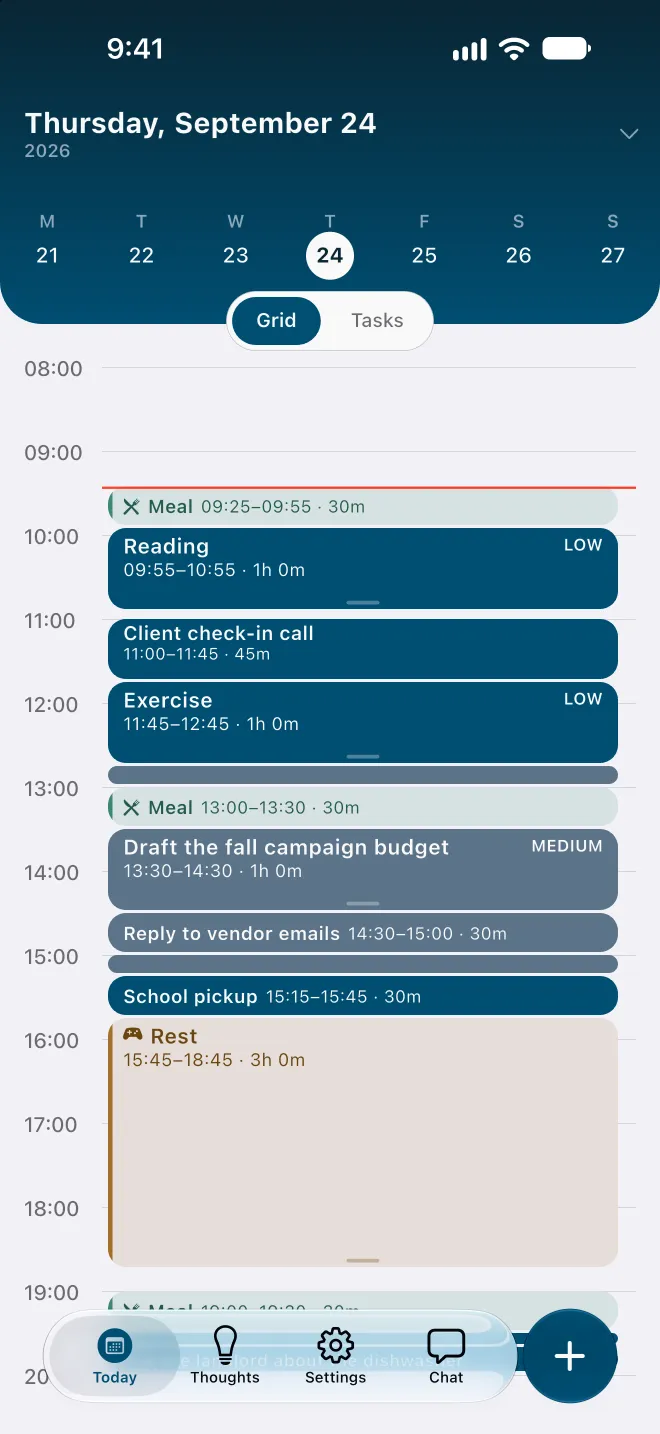
If you plan in Flowo, enter each block above as a task with an estimated duration and a deadline (the two halves of the reading as two tasks), and enter the lecture as an event. The scheduler places the tasks around the lecture and the meal block in your schedule template, and you can drag or lock any block, for example the first reading block at 9am. If the morning slips, re-planning proposes new times for the unfinished work in the hours that are left.
When this does not work
Long sessions. The experiments used short tasks, about four minutes per passage in Thompson et al. (2012), and several had 20 to 30 participants. None of these studies measured a three-hour evening of study, so the cost could fade as you get used to the sound or grow as you tire.
A noisy room. Silence was the comparison in most studies. In a busy library or a shared kitchen, nearby conversation may be the larger problem, since intelligible speech was among the most disruptive sounds for reading (Vasilev et al., 2018). A quieter room or earplugs gets you closer to the conditions the studies tested.
People who like a lot of stimulation. Costs differed between introverts and extraverts (Cheah et al., 2022) and with a person's taste for outside stimulation (Gonzalez & Aiello, 2019). The cost may be smaller for some readers, and the 20-minute test is a quick way to check where you sit.
When music is the reason you sit down. If a playlist is what gets you to the desk on a hard day, keep it for the warm-up and the hands tasks, and turn it down or off when the dense reading starts.
Questions
Is lo-fi or classical music better for studying?
For reading, the lowest measured cost comes from music without lyrics at a moderate tempo and low volume, so treat a lo-fi track with vocal samples as music with words. One meta-analysis found a small advantage for classical music in learning outcomes (de la Mora Velasco et al., 2023).
Does music I like help me concentrate?
Liking a song did not protect reading comprehension when the song had lyrics (Perham & Currie, 2014). In another study, music students preferred for studying did not lower comprehension significantly, while music they did not prefer did (Johansson et al., 2012). The published summary does not say whether the preferred music had lyrics, so preference alone is a weak guide.
Does the Mozart effect exist?
Husain et al. (2002) found that changing a Mozart sonata's tempo and mode changed listeners' arousal and mood, and spatial performance followed those changes. The authors conclude that the effect is a consequence of arousal and mood. That is one reason to try a few minutes of upbeat music before a session.
References
- Cheah, Y., Wong, H. K., Spitzer, M., & Coutinho, E. (2022). Background music and cognitive task performance: A systematic review of task, music, and population impact. Music & Science, 5. https://doi.org/10.1177/20592043221134392
- de la Mora Velasco, E., Chen, Y.-T., Hirumi, A., & Bai, H. (2023). The impact of background music on learners: A systematic review and meta-analysis. Psychology of Music, 51(6), 1598-1626. https://doi.org/10.1177/03057356231153070
- Gonzalez, M. F., & Aiello, J. R. (2019). More than meets the ear: Investigating how music affects cognitive task performance. Journal of Experimental Psychology: Applied, 25(3), 431-444. https://doi.org/10.1037/xap0000202
- Husain, G., Thompson, W. F., & Schellenberg, E. G. (2002). Effects of musical tempo and mode on arousal, mood, and spatial abilities. Music Perception, 20(2), 151-171. https://doi.org/10.1525/mp.2002.20.2.151
- Johansson, R., Holmqvist, K., Mossberg, F., & Lindgren, M. P. (2012). Eye movements and reading comprehension while listening to preferred and non-preferred study music. Psychology of Music, 40(3), 339-356. https://doi.org/10.1177/0305735610387777
- Perham, N., & Currie, H. (2014). Does listening to preferred music improve reading comprehension performance? Applied Cognitive Psychology, 28(2), 279-284. https://doi.org/10.1002/acp.2994
- Thompson, W. F., Schellenberg, E. G., & Letnic, A. K. (2012). Fast and loud background music disrupts reading comprehension. Psychology of Music, 40(6), 700-708. https://doi.org/10.1177/0305735611400173
- Vasilev, M. R., Kirkby, J. A., & Angele, B. (2018). Auditory distraction during reading: A Bayesian meta-analysis of a continuing controversy. Perspectives on Psychological Science, 13(5), 567-597. https://doi.org/10.1177/1745691617747398
Conflict of interest: the author is a co-founder of Flowo, a planning app. None of the studies cited was funded by or connected to Flowo.
Related: breaking a task into steps, cognitive load and calm, what executive function apps can and can't do, and how the scheduler decides where tasks go.
Flowo is free to download on the App Store for iPhone and on Google Play for Android, with optional in-app purchases.