 Flowo
Updated
Why clean in small, timed pieces
"Clean the flat" has no edges. It does not say where to begin, how long it will take or when you are allowed to stop, so it is easy to postpone until the mess forces the issue. A timed piece has all three: one room, one size, and a chime at the end.
Research on putting things off links procrastination with tasks people find unpleasant, and with how far away the reward feels (Steel). A chore is often both. People also tend to underestimate how long their own tasks take, even when they know similar tasks ran late before (Buehler and colleagues), which is why a plan to "do the whole kitchen tonight" so often ends half done. A piece with a fixed length sidesteps the estimate. You are not promising to finish the kitchen, only to spend ten minutes on it.
Starting is often the hardest step, and the task initiation entry explains why it counts as a skill of its own. The checklist below is built so the first step is always small and visible: one counter, one sink, one basket.
The room-by-room checklist
Pick a room, pick a size, and start the matching timer. When the chime plays, the piece is done, finished or not. If you want to keep going, start the next size up. Each size has a free timer that runs in your browser:
- 5 minutes: one surface or one small job, for days when starting is the hard part. Start the 5 minute timer.
- 10 minutes: one full job, or the surfaces of one room. Start the 10 minute timer.
- 15 minutes: a reset of one room, with surfaces, floor and trash. Start the 15 minute timer.
| Room | 5 minutes | 10 minutes | 15 minutes |
|---|---|---|---|
| Kitchen | Clear the counter by the sink | Load or empty the dishwasher, wipe the counters | Dishes, counters, stovetop, trash out |
| Bathroom | Wipe the sink and the mirror | Sink, mirror and toilet | Sink, toilet, a quick shower wipe, the floor |
| Bedroom | Clothes off the floor and into the basket | Make the bed, clear the nightstand | Bed, surfaces, clothes away, the floor |
| Living room | Cups and plates back to the kitchen | Clear the coffee table, fold the throws | Surfaces, cushions, a quick vacuum |
| Entry and desk | Shoes paired, keys on their hook | Mail sorted into trash and action | Desk cleared to the surface and wiped |
| Laundry | Start a load | Move a load to the dryer or the rack | Fold and put away one basket |
The pieces are deliberately plain. A checklist you have to interpret becomes another decision, and the point is to remove decisions, not add them. If a room in your home needs a different list, cross out a line on the printable and write your own: the sizes matter more than the exact jobs.
Two rules keep the list useful. First, tick what you did, not what you did not do; a sheet full of gaps reads as failure, and it is only a record of a busy week. Second, stop when the timer ends unless you actively want to continue. Stopping on time keeps the promise small, and a small promise is easier to make again tomorrow.
A weekly cleaning schedule
A weekly rhythm decides in advance which room gets attention, so there is no daily choice about where to start. This one gives each weekday one room and keeps the daily part to ten minutes:
- Every day, 10 minutes: dishes and the kitchen counters, ideally right after the evening meal.
- Monday: a 15 minute kitchen reset.
- Tuesday: the bathroom.
- Wednesday: the bedroom, and one load of laundry from machine to drawer.
- Thursday: the living room.
- Friday: the entry and the desk, plus 15 minutes on the doom pile if there is one.
- Saturday: one catch-up piece for whatever slipped this week. Only one.
- Sunday: trash and recycling out, and a look at the week ahead.
Tie each piece to something that already happens, such as "after dinner, I wipe the counters" or "when I get home on Tuesday, I do the bathroom". Plans in that when-then form are called implementation intentions, and a meta-analysis of studies on them reported medium-to-large effects on reaching goals (Gollwitzer and Sheeran). The studies were not about cleaning, but the shape of the plan carries over.
A missed day does not move the week. Skip it and do the next day's room, and let Saturday's catch-up piece absorb the rest. The Journal looks at what research says about whether habits survive a missed day.
How to handle a doom pile
A doom pile is a heap of mixed things, such as mail, receipts, cables and half-finished projects, that gets moved from place to place instead of dealt with. Each item in it is a small decision that was put off. That is why a pile is so hard to face: it looks like one job and is really forty.
In a study of 192 college students, people who reported more clutter also reported more procrastination over both decisions and routine tasks (Prohaska and colleagues). It measured a link, not a cause, but it fits what people describe. The way through is to make the decisions small and fast, and to write down the ones that cannot be made yet.
- Start a 15 minute timer. The aim is to sort, not to finish.
- Make four spots: trash, belongs elsewhere, needs action, stays here.
- Pick up each item once and put it in one spot. If you cannot decide in a few seconds, it goes in needs action.
- When the timer ends, take out the trash and carry the elsewhere items to their rooms.
- Write each needs-action item as a task with a time, such as "pay the water bill, 10 minutes, Friday".
The last step is the one that stops the pile from coming back. In experiments on unfinished goals, making a specific plan reduced how often the goal intruded on later work, even before it was done (Masicampo and Baumeister). A bill with a time attached is a plan. A bill on a chair is a reminder that keeps going off.
The free printable checklist
Download the one-page ADHD cleaning checklist (PDF). It is sized for US Letter and keeps wide margins, so it also prints on A4 without anything cut off.
- The room-by-room checklist, with a tick box for each 5, 10 and 15 minute piece.
- The weekly cleaning schedule, one room a day.
- The four-spot method for a doom pile.
- A short line of blank space for the week's one catch-up piece.
Print one a week and tick in pencil, or keep one in a plastic sleeve on the fridge with a whiteboard pen. In a shared home, give each person their own copy and it works as a simple ADHD chore chart: everyone sees which pieces are theirs, and nobody has to hand out jobs.
How Flowo fits chores into free time
A checklist says what to clean. It does not say when, and on a full day "later" tends to mean "not today". That part is what Flowo, a day planner for iPhone and Android, is built for. In Flowo a chore is a task like any other, with a duration and a deadline, and the planner places it in free time around your fixed events, meals and sleep.
- One-off chores go in as tasks: "Defrost the freezer, 30 minutes, by Saturday."
- Repeating chores go in as habits with a rhythm, such as the bathroom once a week or laundry twice a week.
- Chores you remember halfway through something else, like "buy bin bags", go into Brain Dump in a few seconds and wait there until you sort them.
- A day that fills up shows it. A chore that no longer fits gets a No room badge, and Recovery shows the ways to still fit it.
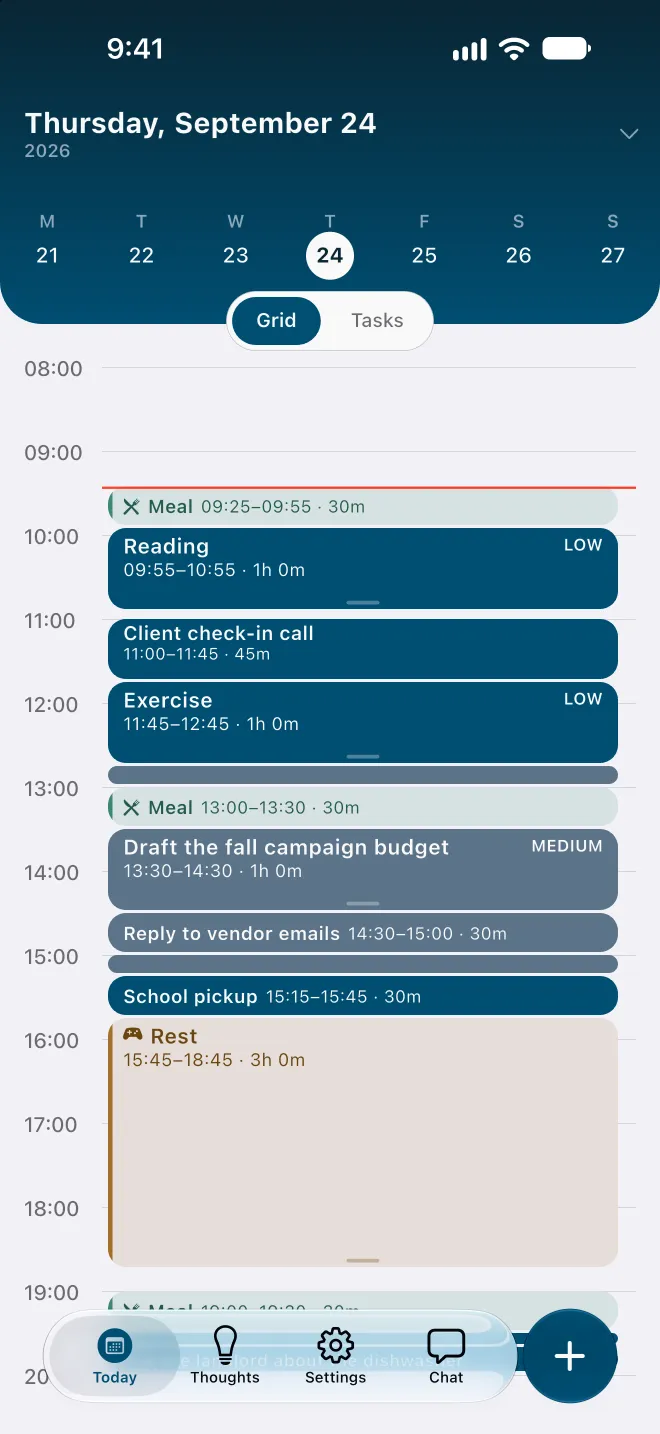
Routine scheduling in Flowo follows fixed rules on your phone, so the same inputs give the same plan, and you can open any block to see why it is where it is. The free plan includes 7 Recovery fixes and 5 Tidy Up runs a week; Flowo Pro removes those limits.
If cleaning alone is the hard part, Ondi Spaces has an Evening Tidy room, where Ondi dusts his bookshelf while you work through yours. Some people find company makes a chore easier to start, and the body doubling entry covers how thin the research on that still is.
Flowo is free to download on the App Store for iPhone and on Google Play for Android. Flowo Pro is an optional in-app purchase: US$4.99 a month or US$29.00 a year, both starting with a 14-day free trial that needs a payment method, or US$44.99 once with no trial. Your store shows the local price before you confirm.
Related reading
When the week slips, read how Flowo re-plans the rest of the day. For the list of everything else on your mind, start with capturing everything first. For appointments that make the hours before them hard to use, see waiting mode. Every timer length, from one minute to two hours, is on the free timers page.
Questions
What is an ADHD cleaning planner?
It is a plan that breaks cleaning into small, timed pieces and gives each one a place in the week, so the decision about what to clean is made before you start. This page and its printable are one version, and Flowo can hold the same pieces as tasks in your day.
How long should a cleaning session be?
Short enough to start. This checklist uses pieces of 5, 10 and 15 minutes, each with its own timer, so every session has a clear end and you can start another piece if you want to keep going.
What is a doom pile?
A doom pile is a heap of mixed, unsorted things that gets moved from place to place instead of dealt with. People often explain the name as an acronym: didn't organize, only moved. The four-spot method above sorts one in fifteen minutes.
Is there an ADHD cleaning app?
Flowo is a day planner rather than a cleaning app, but it can hold chores: enter each one as a task with a duration, or as a habit with a rhythm, and the planner places it in free time around your events, meals and sleep. It is free to download on iPhone and Android.
Can I print the checklist on A4 paper?
Yes. The PDF is US Letter size with wide margins, so it prints on A4 without anything cut off. If your printer asks, choose "fit to page".
Is this page medical advice?
No. Flowo is a planning tool, and this page is about arranging chores. If difficulties with daily tasks affect your life, a doctor or psychologist is the person to talk to.
Sources
- Steel, P. (2007). The nature of procrastination: A meta-analytic and theoretical review. Psychological Bulletin, 133, 65–94, accessed 2026-11-18
- Buehler, R., Griffin, D., & Ross, M. (1994). Exploring the "planning fallacy". Journal of Personality and Social Psychology, 67, 366–381, accessed 2026-11-18
- Gollwitzer, P. M., & Sheeran, P. (2006). Implementation intentions and goal achievement: A meta-analysis. Advances in Experimental Social Psychology, 38, 69–119, accessed 2026-11-18
- Prohaska, V., et al. (2018). Assessing "clutter" and related constructs with a non-White, urban sample. Current Psychology, 37, 432–435, accessed 2026-11-18
- Masicampo, E. J., & Baumeister, R. F. (2011). Consider it done! Plan making can eliminate the cognitive effects of unfulfilled goals. Journal of Personality and Social Psychology, 101, 667–683, accessed 2026-11-18