 Flowo
Yes. In the one study that tracked new habits day by day, skipping a single repetition left progress on the same curve, and a typical habit took about two months to feel automatic, so one day is a small slice of the work. The missed-day finding rests on that single study of 82 people plus theory, while the two-month figure has moderate support from a trial and a meta-analysis; separate experiments suggest the larger cost of a miss comes from how it is recorded and judged.
What the research says
Habits take months, and people vary a lot. Lally et al. (2010) asked 96 volunteers to pick one healthy behaviour, such as drinking a glass of water after breakfast, and repeat it daily in the same context for 84 days. Among participants whose data fitted the model, the time to reach 95% of their personal ceiling of automaticity ran from 18 to 254 days, with an average later summarised as 66 days (Gardner et al., 2012). A trial with 192 adults found a median of 59 days (Keller et al., 2021), and a meta-analysis of 20 studies with 2,601 participants reported medians of 59 to 66 days and individual times from 4 to 335 days (Singh et al., 2024). Its authors rated 11 of the 20 studies at high risk of bias, so read these numbers as a rough scale.
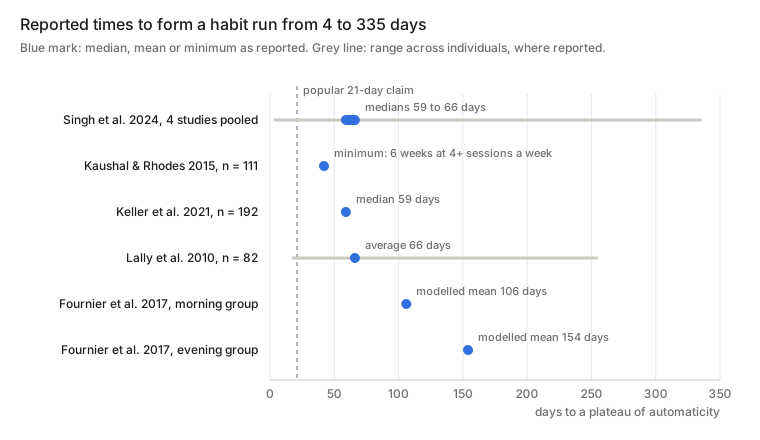
One missed day left the learning curve intact. Lally et al. (2010) also recorded whether people did their behaviour each day. When someone skipped a single opportunity, automaticity kept growing along the same curve. That fits the view of habit as a slowly built link between a setting and an action, which an occasional skip barely moves (Wood & Neal, 2007). People who repeated more consistently over the 84 days still produced cleaner curves, and nobody has tested what two or more misses in a row do.
The record of a miss can hurt more than the miss. Across seven studies, Silverman and Barasch (2023) showed people logs of behaviours they track over time. People who saw a broken streak engaged less afterwards than people who saw an intact one, even when their actual past behaviour was the same. The drop grew when people blamed themselves for the break and shrank when they were allowed to repair the streak. The finding cuts both ways: intact streaks raised engagement, so a streak helps for as long as it holds.
A kind reading of failure kept people trying. In four experiments, Breines and Chen (2012) guided some people toward a self-compassionate view of a personal failure. Compared with control groups, they spent more time preparing for a difficult test after an initial failure and reported more motivation to change a weakness. The samples were students and the outcomes short-term.
Repetition in a stable setting does the work. In the Keller et al. (2021) trial, repeating the plan predicted automaticity, and tying the behaviour to a daily routine worked about as well as tying it to a clock time. Repetition binds an action to features of its setting until the setting alone prompts it (Wood & Rünger, 2016). New starts may help as well: searches for dieting and gym attendance rose after temporal landmarks such as a new week or month (Dai et al., 2014).
How to do it
- Tie the habit to one cue you meet every day. Write it as a sentence: "After I pour my first coffee at 7:15, I walk for 20 minutes." A routine and a clock time worked about equally well, so pick whichever holds on your busiest weekday.
- Set a weekly target and count repetitions. Five walks a week, tallied on Sunday evening. Four walks go in the log as four. For exercise, new gym members needed at least four sessions a week, kept up for six weeks, to form a habit (Kaushal & Rhodes, 2015).
- Mark a review date ten weeks out. If you start on a Monday, put a note on the Monday ten weeks later. Typical medians sat around 59 to 66 days, so a walk that still takes effort in week five is on schedule.
- After a miss, return at the next usual cue. Skipped Tuesday's 7:15 walk? The next one is Wednesday at 7:15. Leave out the 40-minute make-up walk at 9pm, because by the setting-based account of habit it would rehearse a different cue.
- Log the miss in one plain line. "Tue: skipped, early train. Next: Wed 7:15." Then tell yourself what you would tell a friend: "Busy morning, back tomorrow."
- Use a rule for two misses in a row. One miss: change nothing. Two in a row: treat it as a sign the plan needs adjusting. Cut the habit in half (20 minutes becomes 10) or move it to a steadier cue, and restart on the next Monday, the kind of landmark that tends to prompt fresh attempts.
A worked example
Say you are three weeks into a 20-minute walk after your first coffee at 7:15, with a target of five weekday walks. Monday and Tuesday went to plan. Here is the rest of the week.
- Wednesday 6:55. Your 9:00 meeting moves to 7:30. You spend the next half hour preparing, and the walk does not happen.
- Wednesday 8:20. The meeting ends. You write one line: "Wed: skipped, early meeting. Next: Thu 7:15." Tally so far: two.
- Wednesday 12:30. You feel the pull to do a long make-up walk. You eat lunch and leave the walk for its usual slot.
- Thursday 7:15. Coffee, then the walk, at the same cue you have used for three weeks. Friday goes the same way.
- Sunday 19:00. Tally: four of five. Four goes in the log, and the review date in week ten stays where it was.
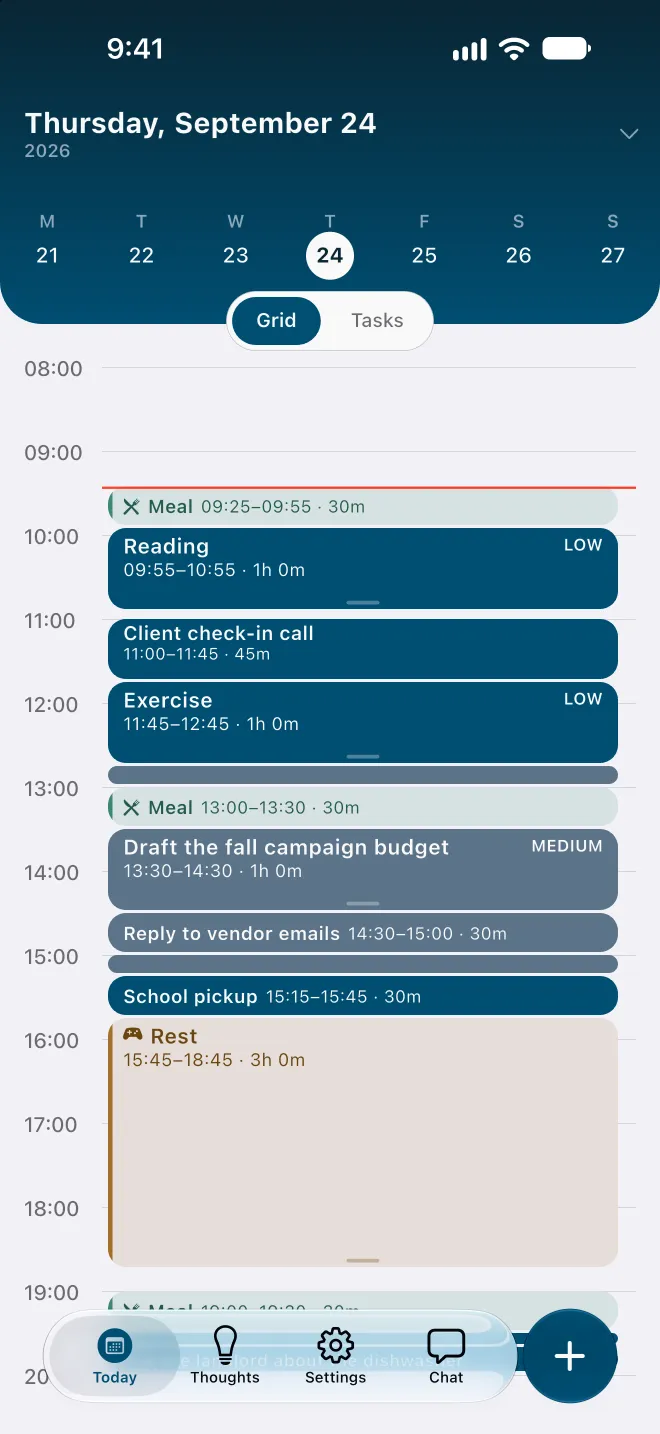
In Flowo, a walk set up as a Habit repeats automatically, so Thursday's slot exists without re-entering it, and you can pin or lock it at 7:15. Habit streaks there are optional and are not required to re-plan unfinished work. If you re-plan Wednesday after the meeting, the app proposes new placements for unfinished work in the time left, and nothing is marked overdue. Every proposed block stays editable.
When this does not work
If you miss more often than you show up. The single-miss result describes people whose daily ratings fitted the model, and frequent missers may have dropped out of that group (Lally et al., 2010). If you hit fewer than half your weekly target for two weeks running, shrink the habit first.
If your days have no stable setting. This method leans on a stable setting (Wood & Rünger, 2016), and rotating shifts or frequent travel keep moving it. Choose a cue that comes with you, such as the first coffee of the day wherever you are.
If a streak works for you. Someone who rarely breaks a streak may keep getting the boost of an intact one (Silverman & Barasch, 2023). The balance tips against streaks as breaks become common, though no study has measured that trade-off directly.
Limits of the evidence. The habit studies here measured how automatic a behaviour felt, and most habit research relies on correlational designs and self-report (Gardner, 2015). The field studies enrolled 48 to 192 people each and tested health behaviours such as stretching and exercise. None of these studies examined adults with ADHD, so the timelines make no claim about them.
Questions
Does it take 21 days to form a habit?
Typical estimates run closer to two months. The 21-day figure traces to a 1960 book by the plastic surgeon Maxwell Maltz, who described patients getting used to their changed appearance in about three weeks and measured no habits (Gardner et al., 2012). A few people in the field studies did reach automaticity within three weeks.
What if I miss two days in a row?
The research has no answer yet. No study has isolated the effect of two or more consecutive misses, and the popular rule "never miss twice" has not been tested as such. A practical response is to resume at the next usual cue and, if the misses repeat, make the habit smaller or move it to a steadier cue.
Are streak trackers a good idea?
They help while the streak lasts. In seven studies, intact streaks raised engagement and a visibly broken one lowered it, more so when people blamed themselves (Silverman & Barasch, 2023). If your schedule changes often, a weekly count avoids the broken-streak display, and in those studies a chance to repair the streak shrank the drop.
References
- Breines, J. G., & Chen, S. (2012). Self-compassion increases self-improvement motivation. Personality and Social Psychology Bulletin, 38(9), 1133-1143. https://doi.org/10.1177/0146167212445599
- Dai, H., Milkman, K. L., & Riis, J. (2014). The fresh start effect: Temporal landmarks motivate aspirational behavior. Management Science, 60(10), 2563-2582. https://doi.org/10.1287/mnsc.2014.1901
- Fournier, M., d'Arripe-Longueville, F., Rovere, C., Easthope, C. S., Schwabe, L., El Methni, J., & Radel, R. (2017). Effects of circadian cortisol on the development of a health habit. Health Psychology, 36(11), 1059-1064. https://doi.org/10.1037/hea0000510
- Gardner, B. (2015). A review and analysis of the use of "habit" in understanding, predicting and influencing health-related behaviour. Health Psychology Review, 9(3), 277-295. https://doi.org/10.1080/17437199.2013.876238
- Gardner, B., Lally, P., & Wardle, J. (2012). Making health habitual: The psychology of "habit-formation" and general practice. British Journal of General Practice, 62(605), 664-666. https://doi.org/10.3399/bjgp12X659466
- Kaushal, N., & Rhodes, R. E. (2015). Exercise habit formation in new gym members: A longitudinal study. Journal of Behavioral Medicine, 38(4), 652-663. https://doi.org/10.1007/s10865-015-9640-7
- Keller, J., Kwasnicka, D., Klaiber, P., Sichert, L., Lally, P., & Fleig, L. (2021). Habit formation following routine-based versus time-based cue planning: A randomized controlled trial. British Journal of Health Psychology, 26(3), 807-824. https://doi.org/10.1111/bjhp.12504
- Lally, P., van Jaarsveld, C. H. M., Potts, H. W. W., & Wardle, J. (2010). How are habits formed: Modelling habit formation in the real world. European Journal of Social Psychology, 40(6), 998-1009. https://doi.org/10.1002/ejsp.674
- Silverman, J., & Barasch, A. (2023). On or off track: How (broken) streaks affect consumer decisions. Journal of Consumer Research, 49(6), 1095-1117. https://doi.org/10.1093/jcr/ucac029
- Singh, B., Murphy, A., Maher, C., & Smith, A. E. (2024). Time to form a habit: A systematic review and meta-analysis of health behaviour habit formation and its determinants. Healthcare, 12(23), 2488. https://doi.org/10.3390/healthcare12232488
- Wood, W., & Neal, D. T. (2007). A new look at habits and the habit-goal interface. Psychological Review, 114(4), 843-863. https://doi.org/10.1037/0033-295X.114.4.843
- Wood, W., & Rünger, D. (2016). Psychology of habit. Annual Review of Psychology, 67, 289-314. https://doi.org/10.1146/annurev-psych-122414-033417
Conflict of interest. The author founded BBMM Technologies, which develops Flowo, a planning app this guide mentions in its worked example.
Related: re-planning a day that slipped, breaking a task into steps, and how the scheduler decides where tasks go.
Flowo is free to download on the App Store for iPhone and on Google Play for Android, with optional in-app purchases.