 Flowo
Hard deadlines you set for yourself have weak support: the best-known experiment reporting that they help was retracted in September 2026, and controlled studies found no gain from binding self-set cut-offs, with lower completion in some conditions. What still stands is that people readily choose to bind themselves, and that soft, near-term commitments helped students make progress in field experiments. Treat the evidence as moderate, since it comes mostly from students doing short tasks.
What the research says
The classic study has been retracted. For two decades, advice on personal deadlines leaned on an experiment reporting that self-imposed deadlines improved performance, though less than evenly spaced deadlines set by someone else (Ariely & Wertenbroch, 2002). A close replication with 124 adults at a large public university in the United States found no significant effect of deadline condition on errors found or days late (Hyndman & Bisin, 2026). Psychological Science retracted the 2002 article in September 2026. The notice says the replication raised questions about the original data and that a dataset believed to relate to the study could not be confirmed as authentic or complete. It also cites an independent investigation that questioned the veracity of the findings, and both authors agreed with the retraction (Retraction, 2026).
People choose binding deadlines, and completion did not improve. Most participants in the replication who were given the option set binding deadlines for themselves (Hyndman & Bisin, 2026). In an earlier field experiment, 278 New York University students alphabetised long word lists online for pay (Bisin & Hyndman, 2020). With a single task, completion was 57.1% for students who could set their own deadline and 45.6% for those who could not, a gap that was not statistically significant. With three tasks over two weeks, completion was 47.0% with no intermediate deadlines, 40.6% with external ones and 36.8% with self-imposed ones, and the gap between self-imposed and none was significant. Each additional day before the deadline at which a student started a task raised the probability of finishing it by about 2.6%, so deadlines that shortened the available time also shortened the time to recover from a failed attempt. A separate field experiment found that evenly spaced interim deadlines lowered completion of a lengthy task (Burger et al., 2011).
Soft commitments helped. University students offered a nonbinding agreement to stay on track for graduation were more likely to register for and pass exams, while a reminder on its own did not change behaviour; students who procrastinated benefited most (Himmler et al., 2019). Among 276 students in online courses, those randomly assigned to microcommitments, small daily tasks with a soft commitment and social accountability, were nearly twice as likely to finish some of the assigned work more than a week before the due date (Felkey et al., 2023). Missing either commitment carried no fine.
Shorter windows reduced delay. People redeemed gift certificates with long deadlines less often than those with short deadlines, although participants predicted the opposite (Shu & Gneezy, 2010). A longer deadline, even one set for reasons that said nothing about the task, led people to judge a goal as harder, and those higher estimates were linked to more procrastination and a higher likelihood of quitting (Zhu, Bagchi, & Hock, 2018).
Hard commitments did raise output in one setting. In a year-long field experiment, full-time data entry workers produced more by voluntarily choosing contracts that penalised low output, and their effort rose as randomly assigned paydays approached (Kaur et al., 2015). That was paid, recurring daily work with money at stake, far from a personal deadline on a one-off project. It cuts against the pattern above without overturning it.
How to do it
- Write the real deadline and a time estimate together. "Client report, due Friday at 5pm, about 6 hours of work."
- Book the opening session within 24 hours. If the report lands on Monday, put 90 minutes on Tuesday at 9am. Starting earlier relative to the deadline raised the chance of completion (Bisin & Hyndman, 2020).
- Make interim targets small, soft promises. Send a one-line message to a colleague: "I'll send you the outline Wednesday afternoon." Nothing bad happens if it slips a day. Nonbinding agreements and small daily tasks with some accountability improved progress for students (Himmler et al., 2019; Felkey et al., 2023).
- Hold back one session as a buffer. Plan the work so it ends with at least one full working session still free before the real deadline, or a quarter of the estimate if that is longer. For 6 hours due Friday at 5pm, the last planned block ends on Thursday and Friday 9 to 11am stays empty. This rule has not been tested; it follows from the finding that near cut-offs left people no time to recover from a failed attempt.
- Give dates to the valuable work first. Before you write "by Thursday" on a 15-minute admin task, check whether it will pull time from a bigger job that has no date. Apparent urgency drew people toward lower-value tasks in experiments, and an independent replication with 2,374 participants confirmed the effect (Zhu, Yang, & Hsee, 2018; Mills et al., 2026).
- Put a 10-minute review at the halfway point. For a two-week project, that is the end of day 7. Groups working to a deadline tended to change their approach at the midpoint of their time (Gersick, 1988, 1989).
A worked example
It is Tuesday. A client review deck is due Thursday at 5pm, and a call at 11am cannot move.
8:50am. Write the task with its real deadline and an estimate: "Client review deck, due Thursday 5pm, about 6 hours." Split it into blocks of 60 to 120 minutes and pencil them into the next three days. In Flowo, the task carries its deadline and estimated duration, and on request a broad task can be split into smaller steps that get their own time slots, placed around fixed events such as the 11am call.
9:00 to 10:30am. The opening session: the outline and the order of the slides.
10:35am. One soft commitment, sent to a colleague: "Outline is done. I'll send you draft slides Wednesday afternoon." No penalty is attached.
11:00 to 11:45am. The client call.
1:30 to 3:30pm. A slide session, planned for two hours. The numbers from finance arrive late, and you get 40 minutes of real work out of it. This is the failed attempt the buffer exists for.
3:35pm. Re-plan what is left. About 3 hours 50 minutes of work remains. Wednesday already holds 9:00 to 10:30am and 2:00 to 3:00pm, so you add 4:00 to 5:20pm on Wednesday and leave Thursday 9 to 11am empty. A planner can do the arithmetic: the app's re-planning proposes new placements for unfinished work in the time that is left, and when a day is too full it tells you what still does not fit.
4:50pm. A five-minute close. Thursday morning is still free, and the colleague has a soft date for the draft. Add a 10-minute review for Wednesday at 1pm, close to the middle of the window.
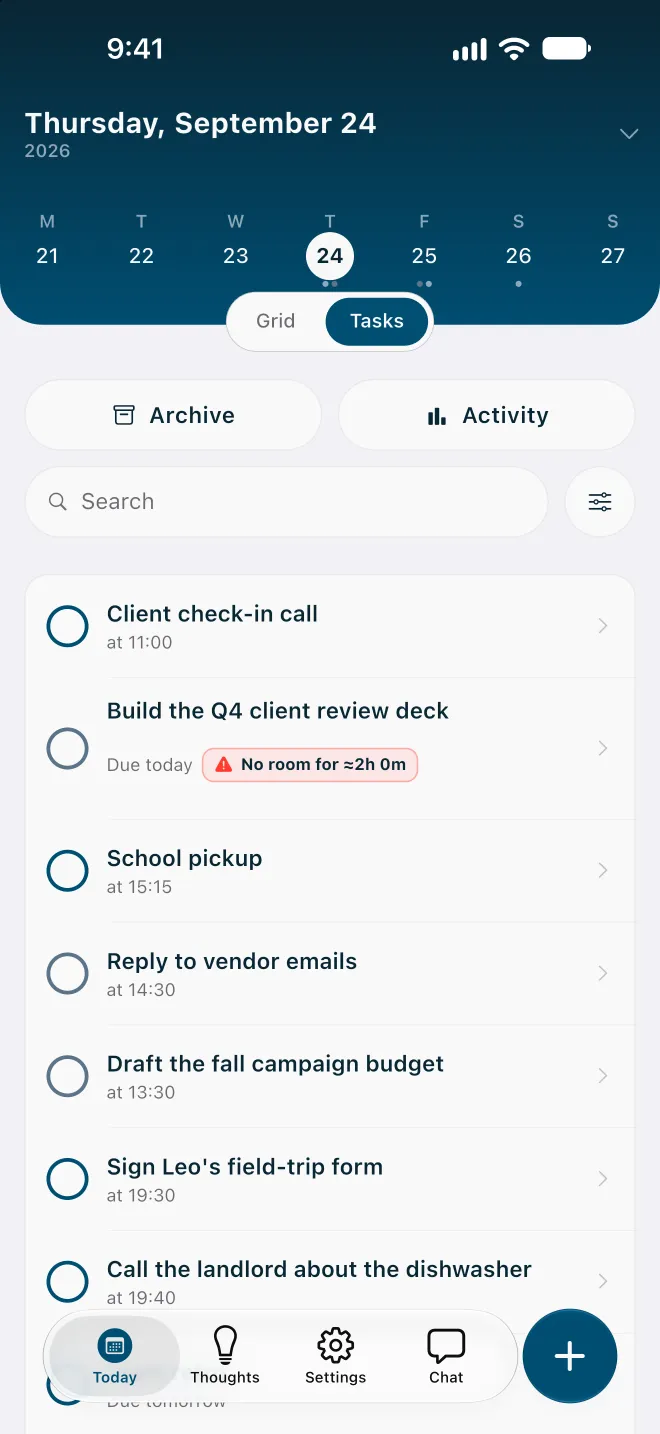
Skip the buffer and Thursday can look like the screen below.
When this does not work
Most studies used students and artificial tasks lasting days or weeks, such as alphabetising word lists or proofreading text, and the clearest negative results come from one research pair at one university. None of these studies randomised adults to self-set deadlines for their own work over months. The buffer rule above is an inference from these studies and has not been tested.
Some work may need a different approach. If your work is paid and recurs daily, a firm daily target with a real cost may suit you better; it raised output in one long field experiment (Kaur et al., 2015). On long projects spread across many sessions, such as a thesis chapter, a single date may do little: earlier predictions of finishing time led to earlier completion for tasks done in one continuous session, with no such effect on tasks that stretched across several (Buehler et al., 2010). And when the work is larger than the time left, no deadline method fixes it. Cut the scope or ask for more time.
Questions
Was the Ariely deadline study retracted?
Yes. Psychological Science retracted Ariely and Wertenbroch (2002) in September 2026, after a close replication found no effect of deadline condition and the original data could not be verified (Hyndman & Bisin, 2026; Retraction, 2026). In the replication, most people given the option still set binding deadlines; the claim that those deadlines improve performance has lost its main experimental support.
Does setting a fake deadline a week early work?
In controlled studies, hard self-set deadlines produced no measurable gain, and in one field experiment they lowered completion (Bisin & Hyndman, 2020). If you want an early date, treat it as soft and leave free time after it, so a failed attempt has room to recover. That combination has not been tested directly.
Why do I work better with a short deadline?
Shorter windows reduced delay in field data on gift certificates (Shu & Gneezy, 2010), and longer deadlines led people to see goals as harder (Zhu, Bagchi, & Hock, 2018). Both findings fit that experience, though both come from consumer settings.
References
- Ariely, D., & Wertenbroch, K. (2002). RETRACTED: Procrastination, deadlines, and performance: Self-control by precommitment. Psychological Science, 13(3), 219-224. https://doi.org/10.1111/1467-9280.00441 (retracted; excluded as evidence)
- Bisin, A., & Hyndman, K. (2020). Present-bias, procrastination and deadlines in a field experiment. Games and Economic Behavior, 119, 339-357. https://doi.org/10.1016/j.geb.2019.11.010
- Buehler, R., Peetz, J., & Griffin, D. (2010). Finishing on time: When do predictions influence completion times? Organizational Behavior and Human Decision Processes, 111(1), 23-32. https://doi.org/10.1016/j.obhdp.2009.08.001
- Burger, N., Charness, G., & Lynham, J. (2011). Field and online experiments on self-control. Journal of Economic Behavior & Organization, 77(3), 393-404. https://doi.org/10.1016/j.jebo.2010.11.010
- Felkey, A. J., Dziadula, E., & Chiang, E. P. (2023). Microcommitments: Mitigating procrastination with more than a nudge. Southern Economic Journal, 90(2), 497-509. https://doi.org/10.1002/soej.12659
- Gersick, C. J. G. (1988). Time and transition in work teams: Toward a new model of group development. Academy of Management Journal, 31(1), 9-41. https://doi.org/10.2307/256496
- Gersick, C. J. G. (1989). Marking time: Predictable transitions in task groups. Academy of Management Journal, 32(2), 274-309. https://doi.org/10.2307/256363
- Himmler, O., Jäckle, R., & Weinschenk, P. (2019). Soft commitments, reminders, and academic performance. American Economic Journal: Applied Economics, 11(2), 114-142. https://doi.org/10.1257/app.20170288
- Hyndman, K., & Bisin, A. (2026). Replication of "Procrastination, deadlines, and performance: Self-control by precommitment." Psychological Science, 37(8), 557-571. https://doi.org/10.1177/09567976261460772
- Kaur, S., Kremer, M., & Mullainathan, S. (2015). Self-control at work. Journal of Political Economy, 123(6), 1227-1277. https://doi.org/10.1086/683822
- Mills, R., Cubitt, R., & Starmer, C. (2026). Brief commentary: An independent replication study of the mere urgency effect. Journal of Consumer Research. Advance online publication. https://doi.org/10.1093/jcr/ucag026
- Retraction: Procrastination, deadlines, and performance: Self-control by precommitment. (2026). Psychological Science, 37(9), 665. https://doi.org/10.1177/09567976261488042
- Shu, S. B., & Gneezy, A. (2010). Procrastination of enjoyable experiences. Journal of Marketing Research, 47(5), 933-944. https://doi.org/10.1509/jmkr.47.5.933
- Zhu, M., Bagchi, R., & Hock, S. J. (2018). The mere deadline effect: Why more time might sabotage goal pursuit. Journal of Consumer Research, 45(5), 1068-1084. https://doi.org/10.1093/jcr/ucy030
- Zhu, M., Yang, Y., & Hsee, C. K. (2018). The mere urgency effect. Journal of Consumer Research, 45(3), 673-690. https://doi.org/10.1093/jcr/ucy008
Conflict of interest: the author is a co-founder of Flowo, a planning app. None of the studies cited was funded by or connected to the company.
Related: should you do the hardest task first, does starting a task help you finish it, re-planning a day that has slipped, and how the scheduler works.
Flowo is free to download on the App Store for iPhone and on Google Play for Android, with optional in-app purchases.