 Flowo
Starting a task probably helps you finish it, mainly because people tend to come back to work they have already begun. The evidence for that pull is moderate and comes largely from laboratory tasks, and no study has tested a "just start for five minutes" instruction with finishing as the outcome. The research also points to a second habit that carries a start through: when you stop, write down the next step and when you will take it.
What the research says
Started tasks tend to get resumed. A 2025 meta-analysis of experiments on interrupted tasks found a general tendency to resume them, along with no reliable memory advantage for unfinished ones (Ghibellini & Meier, 2025). That supports a narrow version of the advice: a task you have started tends to be picked up again when the chance comes. Most of the studies used laboratory tasks.
Visible progress speeds people up. In a café reward programme, customers handed a 12-stamp card with two stamps already filled finished the ten required purchases faster than customers with a plain 10-stamp card (Kivetz et al., 2006). In four further studies, attention to the work already done kept people going early in a goal, and attention to the work remaining did so near the end (Koo & Fishbach, 2012). A short start gives you something to count.
The pull can sag in the middle, and a first win can stop you. Motivation can be higher near the start and the end of a goal and lower around halfway (Bonezzi et al., 2011). In four studies, people who dwelt on one completed step often treated it as a substitute for further effort, while people who read it as a sign of commitment to the larger goal were more likely to continue (Fishbach et al., 2006). This is the evidence that cuts against "just start". A start can lead to more work or to less.
An open task left hanging has costs. In a 12-week diary study of 59 employees, more unfinished tasks on a Friday went with poorer sleep that weekend, through rumination (Syrek et al., 2017). The data were self-reported. In three lab experiments, longer and more demanding interruptions made a task slower to resume, and rehearsing the goal during the break reduced that cost (Monk et al., 2008). Those breaks lasted up to about a minute.
A specific plan quiets an unfinished goal. Across several studies, active and unfinished goals produced intrusive thoughts and hurt performance on unrelated tasks. When participants made specific plans for those goals, the effects disappeared (Masicampo & Baumeister, 2011). The result comes from a single research group, so treat it as promising and unconfirmed.
None of these studies asked people to start an avoided task for a few minutes and then counted who finished. The steps below are built from the separate findings.
How to do it
- Give a first piece 15 minutes, and pick one that leaves a mark. For a quarterly report due Friday, that could be the five section headings plus last quarter's figures pasted in. Choose something you will see when you come back.
- Take that piece from the hard part. An easy opening step can feel like enough and turn into a reason to stop (Fishbach et al., 2006). If the hard part is explaining a sales dip, spend the 15 minutes there, even on three rough bullet points.
- Count what is done early, and what is left late. Write "1 of 5 sections drafted" at the top of the document. Past halfway, change it to "2 sections left, about 50 minutes" (Koo & Fishbach, 2012).
- Stop at a natural break, and leave a two-line note. Line one is the next action, written so you could start it cold: "Write the summary paragraph from the figures table." Line two is when: "Today, 2:00pm, 40 minutes." It mirrors the specific plans that removed the pull of unfinished goals in the lab (Masicampo & Baumeister, 2011).
- Put the return time in your calendar, and keep the gap short. Longer interruptions slowed resumption in the lab (Monk et al., 2008). Those breaks lasted about a minute, so choosing 2pm over "sometime this week" is a reasonable guess that nobody has tested over hours.
- Plan a break for the middle. Around halfway, expect your drive to dip (Bonezzi et al., 2011). Take 10 minutes with a set end time, and write the next step before you stand up.
- On Friday afternoon, give every open task a next step. Spend 10 minutes writing a next action and a day for each started task. Unfinished Friday tasks went with more rumination and poorer weekend sleep (Syrek et al., 2017); pairing them with plans is a combination nobody has tested directly.
If you keep one rule from this guide, keep this one: a started task does not get closed until it has its two-line note.
A worked example
It is Wednesday. A quarterly report is due Friday at noon, and you estimate two and a half hours for it. You have meetings from 10:00 to 12:00 and a school pickup at 3:30.
9:10. You open a blank document and set a 15-minute timer. The hard part is explaining why sales dipped in August, so you start with three rough bullet points on the causes, then add the section headings.
9:25. The timer goes off. The figures table is half built, so you keep going.
9:45. The table is done, a clean place to stop. At the top you write: "1 of 5 sections drafted. Next: write the summary paragraph from the table. Today, 2:00pm, 40 minutes." You add a 2:00 block to your calendar and close the file.
2:00. You read the note and start writing. By 2:40 the summary is done and the top line says "2 of 5". You are near halfway, where the drive can dip, so you write the next step first: "Costs section, use the vendor invoices folder. 2:50, 25 minutes." Then you take a 10-minute break.
2:50 to 3:15. The costs section. The top line becomes "2 sections left, about 50 minutes."
3:15. Before pickup, the last note: "Next: recommendations, start from the August bullets. Thursday 9:00, 50 minutes." That slot goes on the calendar too.
Thursday, 9:00 to 9:50. The last two sections. Friday morning is free for a read-through.
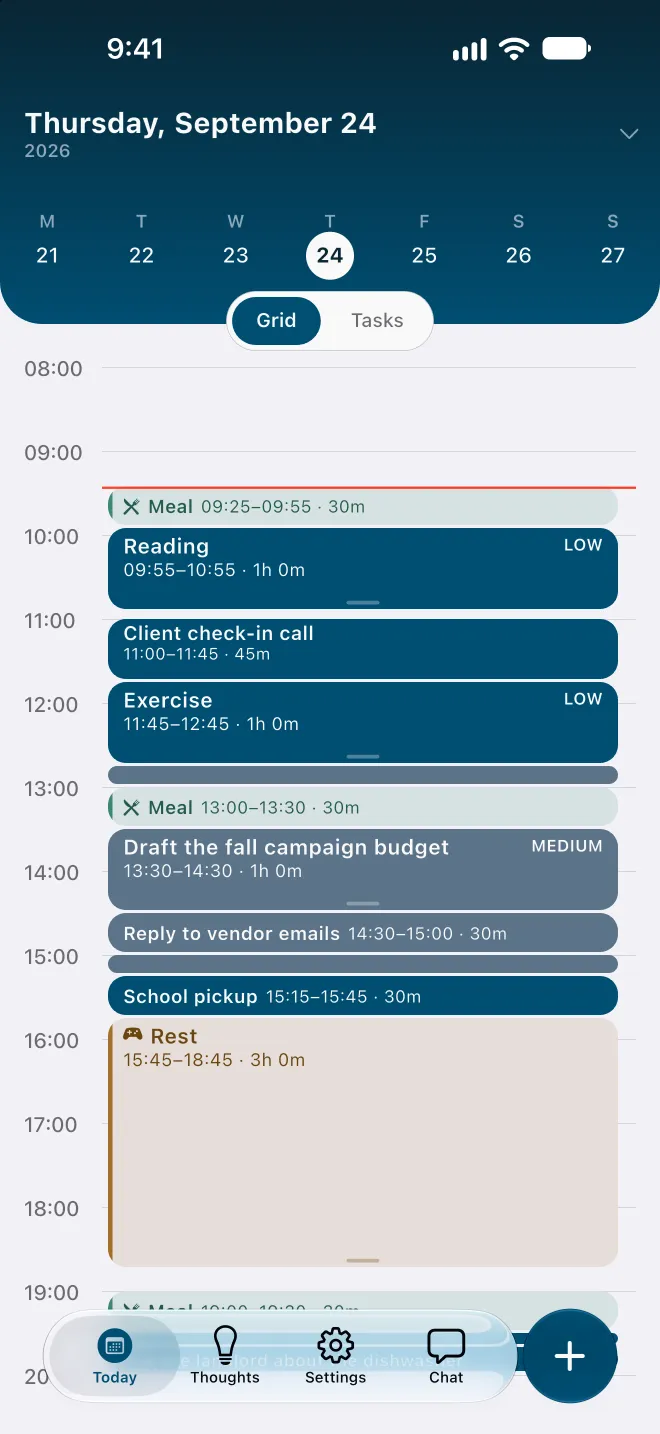
A planner can hold the return times for you. In Flowo, you can enter the report as a task with a 150-minute estimate and a Friday deadline and ask for it to be split into smaller steps that you edit. The scheduler then gives each step its own time slot around your meetings and the pickup. If Wednesday slips, re-planning proposes new placements for the unfinished sections in the time that is left.
When this does not work
When you do not know what the task is. A timer cannot start work that has no first step. Spend the 15 minutes listing steps; the guide to breaking a task into steps covers how.
When getting back in is expensive. A data analysis or a chapter you must reread before adding to it needs a long warm-up. Resumption costs grew with task demands in the lab (Monk et al., 2008), so one protected 90-minute block may serve you better than several short starts.
When the first step becomes the finish line. If you keep doing the easy setup and stalling, the pattern matches the substitution effect (Fishbach et al., 2006). Move your first 15 minutes into the hardest part.
When you want certainty. The evidence comes from lab tasks plus field data from a café and from workplaces, and the direct test has not been run. Treat this guide as a sensible bet built from related findings.
Questions
Does the five-minute rule work?
No peer-reviewed experiment we know of has tested it with finishing as the outcome. The related evidence fits it, since people tend to resume tasks they have started (Ghibellini & Meier, 2025). Adding a written next step and a return time brings in the part with the most direct support (Masicampo & Baumeister, 2011).
Is the Zeigarnik effect real?
The memory version looks weak. A 2025 meta-analysis found no reliable memory advantage for unfinished tasks and a general tendency to resume them, which is the related Ovsiankina effect (Ghibellini & Meier, 2025). The authors suggest the memory effect depended on conditions common in early experiments, such as the authority of the experimenter.
Should I stop in the middle of a task or at the end of a section?
The research does not compare the two directly. Longer and more demanding interruptions made lab tasks slower to resume (Monk et al., 2008), and specific plans removed the intrusive effects of unfinished goals (Masicampo & Baumeister, 2011). Wherever you stop, write the next step and a time first; a natural break makes that note easier to write.
References
- Bonezzi, A., Brendl, C. M., & De Angelis, M. (2011). Stuck in the middle: The psychophysics of goal pursuit. Psychological Science, 22(5), 607-612. https://doi.org/10.1177/0956797611404899
- Fishbach, A., Dhar, R., & Zhang, Y. (2006). Subgoals as substitutes or complements: The role of goal accessibility. Journal of Personality and Social Psychology, 91(2), 232-242. https://doi.org/10.1037/0022-3514.91.2.232
- Ghibellini, R., & Meier, B. (2025). Interruption, recall and resumption: A meta-analysis of the Zeigarnik and Ovsiankina effects. Humanities and Social Sciences Communications, 12, Article 962. https://doi.org/10.1057/s41599-025-05000-w
- Kivetz, R., Urminsky, O., & Zheng, Y. (2006). The goal-gradient hypothesis resurrected: Purchase acceleration, illusionary goal progress, and customer retention. Journal of Marketing Research, 43(1), 39-58. https://doi.org/10.1509/jmkr.43.1.39
- Koo, M., & Fishbach, A. (2012). The small-area hypothesis: Effects of progress monitoring on goal adherence. Journal of Consumer Research, 39(3), 493-509. https://doi.org/10.1086/663827
- Masicampo, E. J., & Baumeister, R. F. (2011). Consider it done! Plan making can eliminate the cognitive effects of unfulfilled goals. Journal of Personality and Social Psychology, 101(4), 667-683. https://doi.org/10.1037/a0024192
- Monk, C. A., Trafton, J. G., & Boehm-Davis, D. A. (2008). The effect of interruption duration and demand on resuming suspended goals. Journal of Experimental Psychology: Applied, 14(4), 299-313. https://doi.org/10.1037/a0014402
- Syrek, C. J., Weigelt, O., Peifer, C., & Antoni, C. H. (2017). Zeigarnik's sleepless nights: How unfinished tasks at the end of the week impair employee sleep on the weekend through rumination. Journal of Occupational Health Psychology, 22(2), 225-238. https://doi.org/10.1037/ocp0000031
Conflict of interest: the author is a co-founder of Flowo, a planning app. None of the studies cited was funded by or connected to Flowo.
Related: breaking a task into steps, re-planning a day that has slipped, and how the scheduler works.
Flowo is free to download on the App Store for iPhone and on Google Play for Android, with optional in-app purchases.